Federico Staksrud: The Argentine Assassin Who Turned Pickleball Into a Full-Time Job
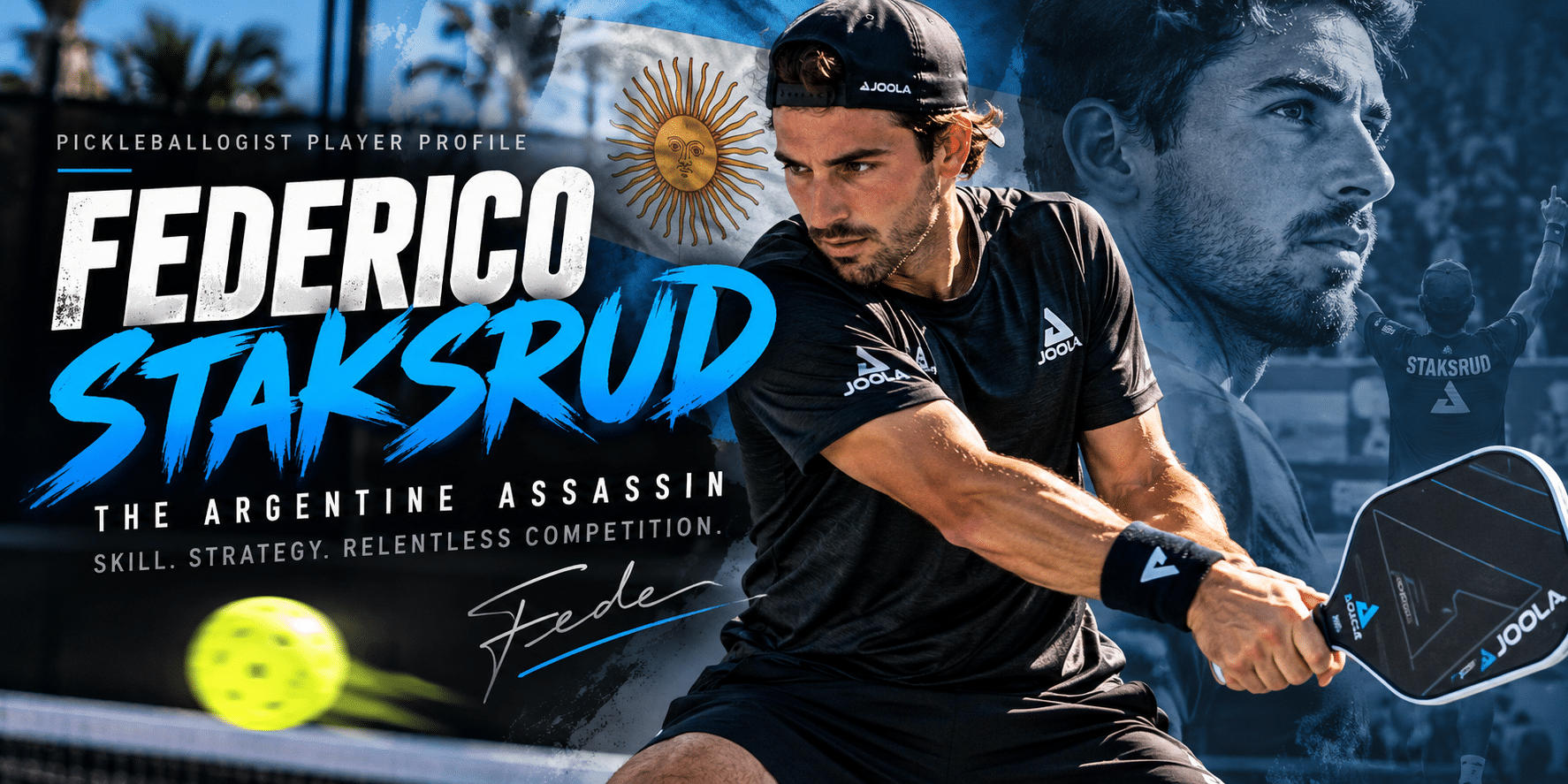
PICKLEBALLOGIST PLAYER PROFILE • BY LLEYTON HOWARD
There are two kinds of former tennis players in pickleball.
The first kind shows up at open play, announces that they played Division I tennis in 1998, and proceeds to launch seventeen consecutive third-shot drives into the back fence. Then they complain about the kitchen rule.
The second kind is Federico Staksrud.
Fede, as practically everyone calls him, came to the United States from Argentina, played college tennis, earned a master’s degree, worked at a software company, and eventually decided that smacking a perforated plastic ball around for a living sounded more appealing than another Tuesday in the office.
The irritating part? He turned out to be spectacularly good at it.

By 2024, Staksrud had reached world No. 1 in men’s singles. By January 2025, he’d also claimed the top spot in men’s doubles. And by 2026, he had accumulated enough professional titles to make most pickleball players consider taking up gardening instead.
But here’s what makes Fede interesting: he isn’t the biggest hitter, the loudest personality, or the most spectacular athlete on tour. His real talent is making extraordinarily difficult pickleball look irritatingly reasonable.
He’s the kind of player who beats you 11–4 without appearing to do anything particularly remarkable.
As a coach, I find that fascinating.
As someone who occasionally enjoys watching a player launch a ball into the neighboring zip code, I find it mildly disappointing.

Let’s get into the man, the madness, the gear, and what those of us whose knees make Rice Krispies noises can actually learn from him.
Who Is Federico Staksrud? From Buenos Aires to the Big Time
The Argentine Tennis Kid Who Idolized Nalbandian
Long before Fede was tormenting Americans with third-shot passing angles, he was growing up in the Palermo neighborhood of Buenos Aires.
Argentina has a serious tennis culture. This is the country that produced Guillermo Vilas, Gabriela Sabatini, David Nalbandian, and Juan Martín del Potro. Its tennis players tend to have excellent footwork, heavy groundstrokes, and an emotional relationship with competition that occasionally resembles a family argument at Christmas.
Young Federico was obsessed.
In a revealing 2024 interview with Argentine newspaper La Nación, Staksrud recalled watching David Nalbandian defeat Roger Federer in the 2005 Masters Cup final. He also admired del Potro’s forehand and Rafael Nadal’s competitive mentality.
Those influences are worth remembering when you watch Fede today.
Nalbandian was a master of redirection and timing. Del Potro could hit a forehand through a brick wall. Nadal treated every point like the fate of civilization depended on it.
Staksrud’s pickleball game contains a little of all three.
There was one problem with his tennis ambitions, though: money.
He told La Nación that he played whatever tournaments were financially accessible but didn’t have the budget to travel internationally as much as he’d dreamed.
At 18, he moved to the United States to pursue college tennis.
College Tennis, Florida, and an Unexpected Career Change
Staksrud played collegiate tennis at the University of New Orleans and Tennessee Wesleyan before eventually studying at Florida Gulf Coast University, where he earned a master’s degree in information systems.
That’s a fairly impressive educational detour for a guy who now makes his living hitting wiffle balls.
While studying, he coached tennis and worked at a software company. His path was heading toward a respectable professional career, complete with spreadsheets, meetings, and the quiet existential horror of corporate calendar invitations.
Then pickleball intervened.
He began playing seriously around 2021, finding himself surrounded by accomplished players including Simone Jardim, Kyle Yates, Pablo Tellez, and others in Florida’s rapidly developing professional scene.
What followed was less a sudden discovery of hidden genius and more an obsessive commitment to improvement.
In a June 2026 television interview, Staksrud described getting up around 5 a.m., practicing pickleball from 6 to 8, then heading into his regular nine-to-five job.
He wasn’t training because someone had promised him a lucrative contract. He was training because he’d rediscovered something tennis had once given him: the joy of competing.
Now, I’m 47. Getting out of bed at five in the morning to exercise sounds like the opening scene of a documentary about a man making terrible decisions.
But that’s the difference between Fede and the rest of us.
He wasn’t just playing pickleball.
He was building a professional athlete’s routine before he was actually a professional athlete.
When Did Federico Staksrud Become a Professional Pickleball Player?
The PPA lists 2021 as Staksrud’s first professional year, although his full-time commitment developed afterward.
In 2022, he entered tournaments throughout Florida and began producing strong enough results to attract professional interest. According to his La Nación interview, an agent approached him about competing full-time, and within approximately two months, his finances supported leaving his other jobs.
Imagine explaining that career move to your parents.
“Mom, Dad, I’ve decided to quit the software industry.”
“Wonderful! Are you joining Google?”
“No. I’m going to play pickleball.”
“…Federico, are you feeling okay?”
It worked out rather well.
The Personality Behind the Perpetually Competitive Face
One of the more interesting things about Staksrud is the contrast between the relaxed guy you hear in interviews and the relentless competitor you see on court.
Off court, he comes across as thoughtful, approachable, and deeply interested in sports beyond pickleball. He’s a fan of Formula 1, tennis, and the NBA.
His 2024 interview also revealed a personal side that rarely makes it into generic athlete biographies. At the time, he was living in Naples, Florida, with his girlfriend Selena, whom he described as an important source of emotional support. His current PPA profile lists West Palm Beach as his home base.
His appreciation for other competitors is equally revealing.
After defeating Hunter Johnson for a singles title in February 2026, Staksrud used his post-match interview to express concern for fellow professional Grayson Goldin, who had been hospitalized after suffering strokes.
It was a small but meaningful moment. He’d just won a major professional match, yet his attention shifted to someone else’s health.
And I think that combination explains part of his appeal.
Fede seems to genuinely enjoy the professional pickleball community, but once a match begins, friendship takes a back seat to figuring out exactly which shot will make your afternoon miserable.
He’s competitive without needing to turn every point into a theatrical production.
Which is refreshing, considering some players celebrate winning a dink rally like they’ve just liberated France.
The Numbers: How Good Is Federico Staksrud, Really?
27
PPA Titles
20
Singles Titles
35
PPA Finals
Career totals displayed on the official PPA athlete page, accessed October 2026. The PPA rankings archive uses a different title-counting snapshot, so historical totals may vary.
I want you to think about that number for a second.
Winning one professional singles title requires surviving a draw full of athletes who have spent most of their lives playing racket sports. Winning twenty requires doing it repeatedly, against opponents who spend their evenings watching film of how to beat you.
And singles is physically brutal. Doubles gives you a partner to cover half the court. Singles gives you an enormous rectangle of exposed real estate and a stern reminder that you should have done more cardio.
Yet singles isn’t even the entire story.
In January 2025, Staksrud reached No. 1 in men’s doubles as well, becoming one of the rare players to hold the top ranking in both disciplines simultaneously.
A Statistical Look at His Singles Dominance
Federico Staksrud’s PPA singles win rate
Percentage of singles matches won by season, calculated from PickleWave’s match records. 2026 is a season-to-date snapshot.
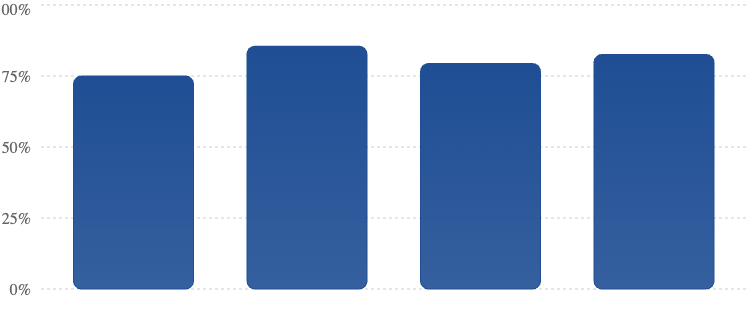
Source: PickleWave match-history database. Percentages are season-specific, and 2026 is incomplete.
In 2024, Staksrud won 100 of his 117 recorded PPA singles matches. That’s an 85.5% win rate.
Imagine walking onto the court knowing that, statistically, your opponent wins more than eight out of every ten singles matches.
I’d probably tell him I had a minor hamstring issue and ask whether he fancied a beer instead.
The impressive thing is that his singles success hasn’t evaporated as the field has improved. His recorded 2026 singles win percentage remains above 80%.
This isn’t one lucky season. It’s sustained excellence.
How Does Federico Staksrud Play? Death by a Thousand Excellent Decisions
If you’re looking for a professional to study, Staksrud is one of my favorites.
Not because you can reproduce his athleticism. Most of us can’t.
It’s because so much of his success comes from skills that can actually be taught: positioning, anticipation, shot selection, and knowing when not to attack.
1. The Singles Game: He’s Playing Chess While Everyone Else Plays Dodgeball
Fede’s singles style is built around controlling space rather than simply overwhelming opponents with power.
One of the best descriptions of his approach came after his February 2026 victory over Hunter Johnson. Tournament coverage characterized Staksrud’s style as a hybrid of traditional cat-and-mouse pickleball and modern baseline aggression.
Johnson preferred powerful passing shots from deep in the court. Staksrud used movement, angles, and calculated approaches to disrupt his rhythm.
Fede won 11–9, 11–7.
What I love about that matchup is that it illustrates two fundamentally different philosophies.
One says, “I’ll hit the ball so hard you can’t return it.”
The other says, “I’ll make you hit a difficult ball from a terrible position, then enjoy the consequences.”
Both approaches work. But Staksrud’s is particularly educational for recreational players.
His point construction frequently follows a recognizable logic: move the opponent, create a shorter reply, approach when the opportunity is favorable, and finish into the open court.
Simple? Sure.
So is playing the piano, provided you ignore all the difficult parts.
2. His Court Coverage Is Ridiculous
Staksrud doesn’t merely run fast. He recovers intelligently.
Watch where he positions himself after hitting a wide forehand. Rather than admiring the shot, he’s already moving toward the opponent’s likely reply.
That recovery step is something I hammer into my students.
Mason, our former college tennis player, understands this instinctively. Tennis teaches you that a beautiful shot is worth precisely nothing if you’re standing in the wrong place when it comes back.
But plenty of recreational pickleball players still treat their best shots like museum exhibits.
They hit a gorgeous crosscourt drive, stand there admiring their handiwork, and then act personally offended when the ball returns.
Fede doesn’t have that problem.
His movement isn’t just about getting to balls. It’s about making the next ball easier.
3. His Aggression Is Selective, Not Timid
There’s a persistent misconception that patient players are defensive players.
Nonsense.
Staksrud can absolutely crush a forehand. But he doesn’t appear interested in proving it on every shot.
He waits until his opponent’s position or ball quality makes aggression worthwhile.
That distinction matters enormously.
A speed-up from below net height against a balanced opponent is a gamble. The same attack against someone leaning the wrong direction is a calculated opportunity.
Staksrud understands the difference.
And this is where the over-40 crowd should pay attention.
You probably aren’t going to develop the reaction speed of a 22-year-old professional by buying another $300 paddle.
But you can absolutely improve your shot selection.
Sometimes the best way to hit a winner is to stop trying to hit one quite so early.
4. Why His Singles Skills Translate to Doubles
There’s a reason Staksrud eventually became a top-ranked doubles player.
Singles forces you to develop exceptional court awareness. You must understand passing lanes, recovery positions, opponent tendencies, and when to transition forward.
Those skills translate beautifully to doubles defense.
But doubles also requires a different kind of patience.
In singles, you can create openings by moving your opponent across a large court. In doubles, there are two people waiting to punish your questionable decisions.
Staksrud has had to develop a more nuanced kitchen game, better coordinated movement, and the ability to build points with a partner.
His doubles success is evidence of that evolution.
It’s also a useful reminder that being a terrific singles player doesn’t automatically make someone a terrific doubles partner.
You still have to learn when to let the other guy hit the ball.
Which, if you’ve ever played with Mason, is apparently a very advanced concept.
The Hayden Patriquin Partnership: Experience Meets Youthful Insanity
One of the more entertaining chapters of Staksrud’s career has been his partnership with Hayden Patriquin.
The pairing works because their games bring different qualities to the court.
Staksrud supplies tremendous experience, court awareness, and the ability to construct points methodically. Patriquin brings youthful explosiveness, aggressive instincts, and the sort of energy I vaguely remember possessing before my fortieth birthday.
In June 2024, they won men’s doubles gold at a tournament in Sacramento, where Staksrud also claimed the singles title.
That was an important milestone.
It showed that Fede could dominate an event not just through his singles abilities but also through high-level teamwork.
The two have continued to be significant figures in men’s doubles, and their partnership is a useful case study in how contrasting personalities can complement each other.
As a coach, I love pairings where one player brings structure and the other brings aggression.
As a doubles partner, I occasionally wish the aggressive player would bring a little less aggression.
Especially when we’re up 10–4.
The Rivalry: Federico Staksrud vs. Christopher Haworth
Every great competitor needs someone who makes life miserable.
For Staksrud, Christopher Haworth has increasingly filled that role.
Haworth is an intriguing opponent because he doesn’t necessarily give Fede the rhythm he wants. His controlled, disciplined approach forces Staksrud to manufacture opportunities against someone who is perfectly comfortable extending rallies.
Their matches offer a fascinating contrast between two highly intelligent players.
At the November 2025 Pickleball World Championships, Staksrud defeated Haworth 11–9, 11–1 to claim the singles championship and regain the No. 1 ranking.
Then, in March 2026, Haworth turned the tables at the Greater Zion Cup, winning 11–9, 11–5 and taking over the top singles ranking.
That’s the kind of rivalry the sport needs.
Not manufactured social media drama. Not two players pretending to hate each other because somebody told them it would improve engagement.
Just two extremely good athletes who keep finding new ways to ruin each other’s weekends.
The 2026 MLP Championship: Fede Becomes the Ultimate Closer
If you thought Staksrud was primarily a singles specialist, his 2026 Major League Pickleball performance offers a compelling counterargument.
Playing for the New Jersey 5s, he helped deliver the team’s championship through two decisive Dreambreaker performances.
For anyone unfamiliar with MLP, a Dreambreaker is a singles tiebreaker in which teammates rotate through short stretches of points.
It’s brilliant television and a magnificent way to give four professional athletes heart palpitations.
Staksrud’s singles pedigree made him particularly dangerous in that format. His ability to cover the court, handle pressure, and manage short bursts of high-stakes play translated directly into team success.
He was named the inaugural MLP Finals MVP in August 2026.
That accomplishment deserves attention because it’s fundamentally different from winning a traditional singles tournament.
In singles, every point belongs to you.
In a Dreambreaker, you’re responsible not only for your own performance but also for your teammates’ championship hopes.
It’s a different kind of pressure.
And apparently Fede quite enjoys it.
What Paddle Does Federico Staksrud Use?

Staksrud’s current paddle is the 16mm Kosmos Pro V, a hybrid-shaped, carbon-faced paddle designed for a balanced all-court game.
Staksrud’s paddle history is almost as entertaining as his tournament history.
He spent years with JOOLA before announcing a high-profile move to Adidas in January 2025. The partnership was supposed to produce a signature paddle.
Instead, Fede played one PPA event with an Adidas paddle before returning to JOOLA equipment while still wearing Adidas apparel.
That’s the pickleball equivalent of announcing you’ve switched from Apple to Android and then being photographed using an iPhone with a Samsung sticker on it.
By June, the Adidas partnership was over. In July, he officially reunited with JOOLA.
I love this episode because it reveals something about professional paddle sponsorships.
Money matters, obviously. But so does equipment confidence.
When you’re competing for world No. 1, you don’t want to spend half your match wondering whether your paddle is going to behave.
The JOOLA Kosmos Pro V: Built for a Thinking Player
The Kosmos Pro V combines aspects of JOOLA’s elongated Perseus shape with the broader sweet spot of its Scorpeus design.
That gives it an interesting personality.
It’s not quite a traditional elongated paddle, and it’s not a stubby widebody. It aims for a middle ground between reach, stability, and maneuverability.
Staksrud’s signature 16mm model emphasizes control through transitions while maintaining enough offensive capability for his singles game.
And unlike a lot of paddle marketing, we have independent measurements to examine.
Federico Staksrud’s Paddle Specifications
| Specification | JOOLA Kosmos Pro V 16mm |
|---|---|
| Shape | Hybrid |
| Length | 16.3 inches |
| Width | 7.7 inches |
| Core thickness | 16mm |
| Average weight | 8.1 oz |
| Handle length | 5.25 inches |
| Grip circumference | 4.25 inches |
| Face | Textured carbon fiber |
| Construction | Thermoformed, foam-enhanced |
| Approvals | USAP and UPA-A |
Manufacturer specifications, with rounded dimensions.
Independent John Kew testing of the standard Kosmos Pro V 16mm, published in the PPA Paddle Lab. The separately listed Federico signature edition has not been individually tested in that database, so these are reference measurements rather than verified measurements of his exact paddle.
Here’s what interests me most.
The standard Kosmos 16mm produced 2,166 RPM of spin and a twistweight of 6.92.
The spin figure places it above the midpoint of the tested paddles in that database, while the twistweight places it considerably higher.
That combination makes sense for Staksrud.
A relatively stable paddle helps when you’re absorbing difficult shots, defending off-center contact, or transitioning through the middle of the court.
And good spin potential is particularly valuable when you’re trying to bring aggressive shots down inside the lines.
The 115.5 swingweight is fairly moderate. It’s not an ultra-lightweight hands machine, but neither is it an enormous sledgehammer.
For me, this is the most interesting aspect of the paddle: it doesn’t chase extremes.
It’s a balanced tool for a player who wins by making consistently excellent decisions.
Would I Recommend Federico Staksrud’s Paddle to Players Over 40?
For advanced players who want an all-court paddle, absolutely worth considering.
But there’s a catch.
At roughly $300, this is a serious purchase. And the fact that Fede uses it doesn’t mean it’ll magically fix your third-shot drop.
If you’re a 3.5 who struggles with control, I’d rather see you master a less expensive paddle before dropping that kind of money.
If you’re a strong 4.0 or 4.5 who wants a combination of reach, stability, and spin, the Kosmos makes considerably more sense.
I’d particularly recommend demoing it if you like the feel of a 16mm paddle but find traditional elongated shapes too unforgiving.
Just remember: the paddle is a tool.
Federico’s footwork, anticipation, and shot selection are doing most of the heavy lifting.
Unfortunately, JOOLA hasn’t figured out how to package those yet.
What Shoes Does Federico Staksrud Wear?
Footwear is a trickier question than his paddle.
Staksrud has worn Adidas court shoes during tournament play, including during his 2025 Adidas sponsorship period. However, his paddle and apparel arrangements subsequently changed, and I couldn’t establish a specific current shoe model with sufficient confidence to recommend it as his definitive 2026 footwear.
What I can tell you is that his movement demands serious court shoes.
A singles specialist like Staksrud needs lateral stability, dependable traction, and enough durability to survive repeated hard-court stops.
And there’s one particularly entertaining footwear-related detail.
After the New Jersey 5s’ 2026 MLP championship victory, Fede celebrated by removing his shoes and socks and throwing them into the crowd.
Yes, really.
Some athletes throw their shirts to the fans. Fede apparently decided somebody deserved a souvenir with considerably more biological history.
I sincerely hope whoever caught those shoes was standing upwind.
Five Things Recreational Players Can Steal From Federico Staksrud
Most of us aren’t going to develop world-class athleticism, but we can borrow a surprising amount from his approach.

1. Recover immediately after every shot.
Don’t admire your forehand. Hit, recover, and prepare. Your next position matters as much as your previous shot.

2. Attack because you’ve created an opening.
Stop attacking simply because you feel like attacking. Move your opponent first, then exploit the space.

3. Use spin to create margin.
Topspin isn’t just for hitting harder. It lets you hit aggressively while improving your chances of keeping the ball inside the baseline.
4. Develop patience without becoming passive.
A neutral ball doesn’t require a heroic response. Sometimes the smartest shot is simply one that improves your position.
5. Train movement, not just paddle skills.
Staksrud’s singles success is built partly on his ability to reach difficult balls and recover. Footwork drills are boring until you realize how many points they save.
Sophie, our tournament-playing teammate, would probably appreciate the patience lesson most. She’s seen enough recreational matches where perfectly good rallies end because someone decides a low-percentage speed-up is suddenly a wonderful idea.
Mason would gravitate toward the movement and court positioning.
Me? I like the decision-making.
At 47, I’m much more interested in winning points intelligently than demonstrating that my hamstrings remain theoretically capable of sprinting.
Frequently Asked Questions About Federico Staksrud
Is Federico Staksrud Argentine?
Yes. Staksrud was born and raised in Buenos Aires, Argentina, before moving to the United States at 18 to pursue college tennis. He now represents Argentina on the professional pickleball circuit.
How old is Federico Staksrud?
Staksrud is 30 years old as of October 2026, according to his official PPA Tour profile.
Has Federico Staksrud ever been ranked No. 1?
Yes. Staksrud has held the No. 1 ranking in men’s singles and men’s doubles. He was simultaneously No. 1 in both disciplines in January 2025.
What paddle does Federico Staksrud use in 2026?
He uses the JOOLA Kosmos Pro V 16mm, his signature model featuring a hybrid shape, textured carbon fiber face, and 16mm core.
What is Federico Staksrud’s best discipline?
Historically, men’s singles has been his strongest discipline by title count, with 20 PPA singles titles listed on his official profile. However, his doubles success and 2026 MLP Finals MVP award demonstrate that he is much more than a singles specialist.
Did Federico Staksrud play professional tennis?
He played competitive collegiate tennis in the United States and coached tennis before transitioning into professional pickleball. His documented background does not establish a substantial ATP Tour career.
Who is Federico Staksrud’s doubles partner?
His partners have varied across tournaments. Hayden Patriquin has been one of his most prominent and successful men’s doubles partners, while he has also competed with Andrei Daescu and others. In mixed doubles, Kate Fahey has been a regular 2026 partner.
Final Thoughts: Why Federico Staksrud Is One of My Favorite Players to Study
Professional pickleball is becoming increasingly obsessed with power.
Every new paddle promises more pop, more speed, more explosive performance, and probably the ability to make your mortgage payment.
Every young player seems determined to hit the ball harder than the last.
And then there’s Federico Staksrud.
A former college tennis player from Argentina who worked in software, trained before sunrise, and built himself into one of the best pickleball players in the world through an almost irritating commitment to doing things properly.
He has power when he needs it. He has speed when he needs it. But what separates him is knowing when those tools are actually useful.
That’s the lesson I’d most like my students to learn.
You don’t have to win every point with a spectacular shot.
You just have to keep making your opponent hit difficult ones.
And if you happen to win a major championship along the way, feel free to celebrate.
Just please keep your socks on.
Research updated October 16, 2026. Career statistics, rankings, sponsorships, and equipment can change during the season. The performance analysis reflects coaching interpretation of documented playing styles and results; it is not presented as original match-tracking or firsthand paddle testing.

I discovered pickleball a few years ago and was instantly hooked. The game itself is exhilarating, but what really drew me in was the sense of community and camaraderie that comes with it. I knew right away that I wanted to be more than just a player; I wanted to contribute to this amazing community in a meaningful way.
As a coach, my goal is to not only improve your game but also to foster a supportive and inclusive environment. I believe that pickleball is more than just a sport; it's a community where everyone should feel welcome, regardless of their skill level.
I'm a firm believer in the power of positivity and encouragement, both on and off the court. Whether you're a beginner looking to learn the basics or an advanced player aiming to refine your skills, I'm here to guide you every step of the way.
When I'm not coaching or playing pickleball, you'll likely find me volunteering at local community events or spending quality time with my family. If you're interested in improving your game or just want to talk about why pickleball is the best sport ever, feel free to reach out. I'm always up for a good conversation and a fun game!
- Federico Staksrud: The Argentine Assassin Who Turned Pickleball Into a Full-Time Job - October 22, 2026
- Selkirk Labs Project Boomstik (Elongated) Review — Big Pop, Big Personality, Bigger Debates - January 20, 2026
- OWL Founders Edition Review: The First “Quiet” Paddle You’ll Actually Want to Use - September 18, 2025