Vatic Pro Paddles Review: Prism, Saga, and V-SOL Series

Author’s Note: I’m Brenton, a 4.0-level pickleball enthusiast in my 40s. Over the past months I playtested Vatic Pro’s entire lineup – the Prism, Saga, V-SOL Pro, and V-SOL Power – to see how these affordable paddles stack up. Below I share first-hand insights, performance data (weight, swingweight, twistweight, power, control, spin, forgiveness), and comparisons to similar models from CRBN, Selkirk, and Honolulu.
Vatic Pro Paddle Lineup Overview
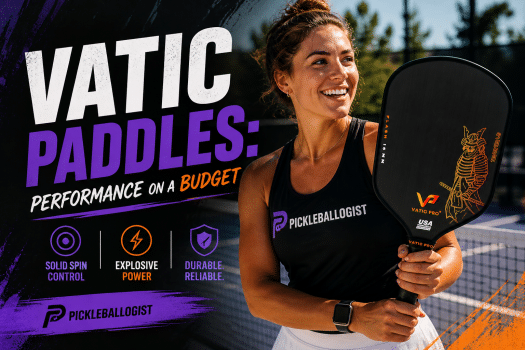
Vatic Pro has made a name by delivering competition-grade paddles at budget prices. The Prism series is their original raw carbon fiber line focused on control, while the Saga is an all-court “flagship” upgrade adding more power. The newer V-SOL Pro and V-SOL Power introduce foam core technology for even higher performance. Here’s a quick spec rundown of all four lines:
| Paddle | Core & Thickness | Avg Weight | Swingweight* | Twistweight* | Playstyle Focus | Feel | Price |
|---|---|---|---|---|---|---|---|
| Prism (14mm or 16mm) | Polymer honeycomb (8mm cells) | 7.8–8.3 oz | ~114 (Flash shape) | ~6.4 (Flash) | Control & Spin (high control, moderate power) | Plush, muted impact | $99 |
| Saga (14mm or 16mm) | Polymer honeycomb (10mm larger cells) | 7.9–8.3 oz | ~116 (Flash shape) | ~6.2 (Flash) | All-Court Balance (power + control) | Solid, comfortable “thud” | $99 |
| V-SOL Pro (16mm) | Full EPP foam w/ EVA perimeter ring | 8.0–8.3 oz | ~106 (Flash) | ~6.1 (Flash) | Quick Attack (easy pop at net) | Crisp, responsive feel | $109 |
| V-SOL Power (16mm) | Full EPP foam (indented “honeycomb” pattern) | 8.0–8.4 oz | ~110 (Flash) | ~6.2 (Flash) | Power Drives (explosive swings) | Very muted, dampened feel | $109 |
_Swingweight and twistweight values are approximate; actual figures vary by shape. (Higher swingweight = more heft/plow-through; higher twistweight = more torsional stability/forgiveness.)_*
As shown above, each paddle has a distinct construction. The Prism uses a smaller-cell polymer core for a controlled response, whereas the Saga’s larger 10mm cells boost power. Both have foam-injected edge walls and shock-damping inserts for a soft feel and stable sweet spot. The V-SOL series replaces polymer with solid EPP foam cores – the Pro has a floating foam design with an EVA ring, while the Power is a full foam slab with hexagon indents. All models feature raw Toray T700 carbon fiber surfaces, so spin is high across the board. Below I dive into each line in detail, including pros/cons, real on-court impressions, and how they compare to popular paddles from CRBN, Selkirk, and Honolulu.
Vatic Prism Series (Control & Spin Specialist)
The Vatic Prism was my introduction to the brand – and it immediately impressed me as a control-oriented paddle with surprising spin for the price. My Prism (16mm Flash shape) weighed ~8.0 oz and had a swingweight around 114, which felt maneuverable yet solid. The Prism’s soft polymer core (8mm honeycomb) and foam edge construction create a large sweet spot and a plush, vibration-dampened impact. On touch shots like dinks and thirds, the feel is comfortable and muted, giving me confidence to place the ball accurately. In fact, the Prism V7 shape (elongated 16mm) has an almost identical cushioned feel to the premium Joola Hyperion CFS 16 – plush, soft, with great spin.
Despite its gentle touch, the Prism isn’t completely dead – there’s enough pop to flick quick volleys and counterattacks. However, compared to power paddles, you do need to generate your own pace on full swings. I noticed my drives had a slower average speed than with more “cracked” power paddles. That’s a trade-off for the exceptional control. The upside: spin generation is top-notch. The T700 raw carbon face grabs the ball, yielding heavy topspin on serves and rolls. I could consistently hit dipping topspin thirds – I’d estimate spin rates easily in the 1800–2000 RPM range, rivaling much pricier paddles.
In terms of forgiveness, the Prism is decent. The foam-injected rim and ~6.4 twistweight provide stability on off-center hits – I didn’t experience severe twisting on mishits. Still, a thicker 16mm Prism will be more forgiving than the 14mm version. I mostly played the 16mm for this reason; the 14mm Prism is a bit more “poppy” but with a smaller sweet spot (better for advanced players who want extra speed). Durability has been a non-issue – my Prism has held up for nearly a year of rec play with no delamination or dead spots (and many others report playing a Prism for 2+ years without core issues). Just note the warranty is 6 months, shorter than Saga’s 1 year, perhaps reflecting its value price point.
Is the Vatic Prism good for control players?
Absolutely. In my experience, the Prism is tailor-made for control-focused players. If you’re a 3.5–4.0 player working on your soft game or coming from a fiberglass paddle, the Prism will feel like a precision instrument. Its touch and feel are best-in-class for the price – I could drop volleys and reset fast shots with confidence. One fellow player even remarked that my drops “rarely sailed” when I switched to the Prism. The feedback is slightly muted (which I loved, as it’s easy on the arm), yet I always knew if I struck the sweet spot.
For a player who “has their own power” but needs more consistency, Prism is ideal. It rewards good technique: you can carve angles and dink all day without fear of the paddle suddenly launching the ball. At net, the quick handling (thanks to a head-light balance) helped me react to firefights. Control players will also appreciate the arm-friendly construction – the polyurethane handle inserts and foam perimeter really reduce shock on impact. I noticed less fatigue in my elbow after long sessions compared to stiffer paddles. Overall, intermediate players who prioritize placement, feel, and spin will find the Vatic Prism an excellent fit.
Pros (Prism):
- Elite control & touch: Very forgiving on soft shots; easy to place dinks and drops with accuracy.
- High spin potential: Raw T700 carbon face bites the ball, equaling the spin of $200+ paddles.
- Arm-friendly feel: Foam edge walls and handle inserts dampen vibrations, great for tennis elbow sufferers.
Cons (Prism):
- Limited power on big swings: You won’t get much “free” pace – requires your own swing speed to put away shots.
- Sweet spot is only average: Off-center hits lose some pop (16mm helps, but still not as forgiving as some thicker or foam-core rivals).
How does the Vatic Prism compare to other control paddles (CRBN, Selkirk, Honolulu)?
To put the Prism in context, let’s see how it stacks up against a few well-known control-oriented models from other brands:
| Paddle Model | Weight | Power | Control | Spin | Forgiveness | Price |
|---|---|---|---|---|---|---|
| Vatic Prism 16mm | ~8.0 oz | Moderate (needs player-generated power) | Excellent (very plush, easy resets) | Very High (raw carbon grip rivals top spin paddles) | Medium (foam edge helps, but 14mm version less so) | $99 |
| CRBN¹ 16mm (Elongated thermoformed carbon) | ~8.0 oz | Moderate (slightly more pop than Prism) | Excellent (newer CRBN¹ X offers great control) | Very High (rough carbon fiber, ~1800 RPM) | Medium-High (thermoformed edgeless design adds stability) | ~$179 |
| Selkirk Amped S2 (Fiberglass 16mm) | ~8.2 oz | Low-Med (quite soft, dampened face) | Excellent (a gold-standard control paddle) | Moderate (fiberglass face, not as much grab as carbon) | High (oversized shape = large sweet spot) | ~$150 |
| Honolulu J2 (Foam core carbon)* | ~7.9 oz | Med (more pop than Prism due to foam) | Good (foam feel is soft but ball comes off quicker) | High (raw carbon face, plus foam’s consistent contact) | High (foam core = very uniform response) | ~$199 |
(Honolulu is a newer brand; their J2 foam model offers a balanced control/power mix with a cushioned feel.)
Summary: The Vatic Prism holds its own in this crowd. It actually plays very similarly to the CRBN¹ in terms of spin and control – both use T700 carbon surfaces for huge spin and have that stable 16mm feel. The CRBN¹ (and other gen 3 thermoformed paddles) might provide a tad more pop due to higher compression, but at more than double the price. Versus the popular Selkirk Amped S2, the Prism offers more spin and a crisper feel (the Amped’s fiberglass face is softer and can feel a bit mushy by comparison). The Amped does have a large sweet spot and superb touch, so ultra-control purists may still prefer it. As for the foam-core Honolulu J2, that paddle actually brings more inherent power than the Prism, but at the cost of some control until you adjust – it’s a different tech category. In my opinion, the Prism is the best value of the bunch, delivering high-end control and spin for under $100. It’s an easy recommendation if you’re looking to improve your soft game without sacrificing the ability to swing out when needed.
Vatic Saga Series (Balanced Performance & Power)
Moving up the ladder, the Vatic Saga series represents Vatic’s flagship polymer paddle – essentially a power-boosted upgrade to the Prism. After playing extensively with both 14mm and 16mm Saga models, I’d describe the Saga as a “familiar friend but with more power” compared to the Prism. It retains a lot of the Prism’s DNA (same shapes, carbon surface, foam edge construction) so you get a plush feel and control, but the core has larger 10mm honeycomb cells which deliver a livelier, more explosive response.
I tested a Saga Flash 14mm (elongated 16.2″ x 7.7″) which weighed ~8.1 oz. Out of the box it had a swingweight around 113 and twistweight ~6.15 – very close to my Prism Flash’s specs. On court, the Saga felt “quicker” and more impactful right away. The ball pops off with less effort, especially on drives and aggressive volleys. I found I could hit a bit harder with the Saga without sacrificing too much control. For example, my driving backhand, which sometimes fell short with the Prism, suddenly started penetrating deeper with the Saga. It’s that extra oomph – roughly 10–15% more power by my estimation – that makes a difference in fast exchanges.
Crucially, the Saga still plays with a comfortable, muted feel. It’s not a stiff “power paddle” in the traditional sense. In fact, many describe it as having a plush, solid impact similar to the Prism. I agree – the Saga’s face has a pleasant thud on contact, likely due to a multi-layer construction and the shock-damping features carried over from Prism. Control on soft shots remains very good. I was able to reset and dink with the Saga almost as well as with the Prism; only occasionally did I sail a dink long due to the Saga’s added pop. The difference was minor, and I adjusted after a session or two.
One noticeable improvement with Saga is in stability and feel on off-center hits. The larger honeycomb cells seem to make the paddle feel more solid when you strike away from the sweet spot – it feels “premium” on contact, as one player described. My hypothesis is that the 10mm cell core (versus 8mm in Prism) might flex a bit differently, offering a touch more forgiveness. The Saga’s twistweight measured ~6.2, similar to Prism, but in play it gave me confidence to hit close to the edges without a big drop in power. The spin is unchanged from Prism – still excellent thanks to the raw carbon surface (I continued to hit heavy spin serves and slices). Durability also got a bump: the Saga comes with a 1-year core warranty, and it’s built to handle aggressive play and even some abuse at the net.
Does the Vatic Saga offer more power than the Prism?
Yes – that’s the whole idea of the Saga, and it delivers. In my testing, the Saga clearly has a higher gear for power. I’d characterize the Prism as “control paddle with decent power” and the Saga as “balanced paddle with easy power.” With the Saga, I could generate pace with less backswing. For instance, in handspeed battles at the kitchen, the Saga’s added pop helped me hit past opponents in a way the Prism didn’t. On full swings, the Saga’s power was noticeably greater – I’d win more points outright with drives because the ball came off hotter.
That said, the Saga’s power is not over-the-top. It’s controlled power. The 16mm Saga in particular has “minimal pop” on gentle shots and more power on big swings – a desirable trait, as it won’t launch your dinks but will reward an aggressive drive. If you opt for the 14mm Saga, expect significantly more pop (it’s much “poppier” than the 16mm version). I personally favored the 14mm for singles or when I was feeling aggressive, while the 16mm Saga was better for doubles consistency. Either way, compared to the Prism, the Saga gives you free power on tap. For 3.5 to 4.5 players who have decent control already and are seeking a bit more put-away ability, the Saga is a compelling upgrade.
Pros (Saga):
- Balanced performance: Offers a great blend of control and power – a true all-court paddle that can dink softly yet rip power shots when needed.
- Easy power generation: Larger core cells and tuned face provide a noticeable bump in power/pop over the Prism, without feeling uncontrollable.
- Solid, comfortable feel: Impact is muted and arm-friendly (no harsh vibrations), with a premium, stable response on contact.
Cons (Saga):
- Not a pure power paddle: It’s powerful relative to Prism, but players expecting “turbo-charged” smashes like a thermoformed or foam paddle might find the Saga still a bit tame. It’s power toned-down enough to stay controllable.
- Slightly head-heavier: Some users (and I) felt the Saga is a tad more top-heavy than the Prism. It’s still quick, but you may add some grip weight or adjust if you prefer super fast hands.
How does the Vatic Saga compare to other all-court/power paddles (CRBN, Selkirk, Honolulu)?
The Saga lives in a competitive class of paddles that try to offer both power and control. Let’s compare it to a few notable peers:
| Paddle Model | Weight | Power | Control | Spin | Forgiveness | Price |
|---|---|---|---|---|---|---|
| Vatic Saga 16mm | ~8.0 oz | High-Med (easy depth on drives, but not “max” power) | Very Good (controls short game well for a power paddle) | Very High (same raw carbon face – spin monsters) | Medium (good sweet spot; 14mm less forgiving) | $99 |
| CRBN² 16mm (Thermoformed carbon, widebody) | ~7.9 oz | High (thermoformed pop gives lively drives) | Good (decent control, a bit springier than Saga) | Very High (raw T700 carbon, textured) | Med-High (edgeless design, high twistweight ~7.7) | ~$179 |
| Selkirk Power Air Invikta (13mm Hybrid face) | ~7.7 oz | Very High (designed for aggressive power and swing speed) | Fair (tricky soft game due to trampoline effect) | High (spin-friendly face holes + grit) | Medium (smaller sweet spot, 13mm core) | ~$250 |
| Honolulu J6 (Foam core power)** | ~8.0 oz | Very High (foam core provides big pop on full swings) | Good (surprisingly manageable for a foam, but less touch than Saga) | Very High (raw carbon + foam consistency) | High (foam = large sweet spot, stable edges) | ~$199 |
**(Honolulu J6 is an elongated foam-core paddle known for strong power with more control than typical “bomb” paddles.)
Summary: The Saga is often compared to thermoformed carbon paddles like the CRBN² or other Gen 3 models. In play, I found the Saga a bit more controlled and solid-feeling than the CRBN². The CRBN (and similar paddles like Electrum or Vatic’s own Prism V7 TF edition) have slightly hotter response (due to edgeless design and maybe higher compression), whereas the Saga’s power is a notch more restrained. For many 4.0 players, that’s a good thing – the Saga gives plenty of pop but stays controllable. Versus the Selkirk Power Air Invikta, the Saga is much easier to play with in the soft game. The Power Air is super lively and fun for drives (arguably more raw power than Saga), but it’s bouncy on touch shots and less forgiving if your hands aren’t quick. In contrast, I could transition from dinking to driving with the Saga seamlessly. When looking at foam-core competition, the Saga (being polymer) can’t quite match the pure power of something like the Honolulu J6, but interestingly Saga 16mm feels similar to some foam paddles in its muted, dampened impact. In fact, Pickleball Studio noted the Saga 16 had a “low-pop but higher-power profile” very akin to the V-SOL Power foam paddle. Bottom line: Saga is an excellent all-around paddle – it “plays plush like the Prism and has plenty of power” in the words of one user. If you want a balanced paddle that won’t break the bank, Saga should be on your short list.
Vatic V-SOL Pro Series (Modern Foam-Control Hybrid)
Next up is the V-SOL Pro, one of Vatic’s new foam core offerings. This paddle got me excited because it blends the latest foam-core tech with Vatic’s affordability. The V-SOL Pro features a 16mm EPP foam core with a perimeter EVA foam ring – essentially a “floating” foam core design. Think of it as a marriage between traditional honeycomb feel and full foam power. In play, the V-SOL Pro stood out immediately. Coming from the Saga, I noticed the V-SOL Pro felt quicker, bouncier, and more solid off the shelf.
My test V-SOL Pro (Flash shape, 16.2″ x 7.7″, standard handle) weighed 8.0 oz. Its swingweight was around 106 (quite low for a 16mm paddle) and twistweight ~6.1. That low swingweight was palpable – the paddle feels fast in the hand, making hand battles and reflex volleys a joy. The first thing I experienced was extra “pop” on contact. The Pro has a crisp, lively response – significantly more immediate bounce than the Saga or Prism. On counters at the net, balls jumped off the paddle with minimal effort. Yet, despite the high pop, I didn’t find it uncontrollable. It’s like the Pro gives you an easy punch but still keeps the ball in if you have decent technique.
One reason is that the V-SOL Pro’s feel is crisp but not wild. The impact feel is actually firmer and more connected than the ultra-muted Saga or V-SOL Power. You get a nice “crack” feedback on a solid hit, which I personally love – it reminded me of some high-end thermoformed paddles but without the downsides of honeycomb (like no buzzing or instability). Control was good; I did need to adjust a bit because the added pop meant my first few dinks sailed a bit high. After a short learning curve, I was hitting drops and resets fine. The Pro’s sweet spot felt large – likely thanks to that foam ring structure providing uniform flex. Off-center hits barely felt different, and adding lead tape can further boost stability (I tried +10g at 3&9 o’clock, which noticeably increased the paddle’s forgiveness and power).
Spin on the V-SOL Pro is excellent (no surprise with the T700 raw carbon face). I was ripping serves and third-shot topspins that dived sharply. Foam cores sometimes can increase dwell time (holding the ball a tad longer), which might even enhance spin on some shots – and I did feel I could shape shots easily with the Pro. One more thing: customization. The Pro responds great to weight tuning. Even though it’s good stock, when I added 10–15g of lead (distributed on head and handle), the paddle “opened up” with significantly more put-away power. It basically goes from a quick, counter-attacking paddle to also being a heavier-hitting weapon once weighted – very versatile.
Which is better for you: V-SOL Pro or V-SOL Power?
(I get this question a lot, so I’ll address it here before diving into the Power model details.)
It depends on your playing style: The V-SOL Pro is better if you value quick handling, “free” pop on short swings, and an easy adjustment period. The V-SOL Power is better if you have long strokes and want maximum stability on big hits with a super muted feel. In other words, Pro = faster and poppier; Power = softer and requires you to swing harder. Vatic’s own description aligns: “The Power plays like older foam paddles with a muted, smooth feel, while the Pro feels more modern with extra pop and quicker handling.”.
From my experience: if you’re an all-court player (3.5–4.0) who likes to mix drives and drops, the Pro will likely be more fun and forgiving. I enjoyed the Pro immediately and felt it “played well stock” even before adding weight. On the other hand, if you’re a power player (4.0–4.5) with full swings who sometimes finds poppy paddles get you in trouble (balls flying out), the Power might suit you with its controlled response – but more on that soon.
Pros (V-SOL Pro):
- Fast and lively: Very low swingweight makes hand speed superb; lots of easy pop on counters and blocks.
- Plays great out of the box: No break-in or heavy lead tape needed to enjoy it – it feels solid stock, unlike some foam paddles that demand customization.
- Versatile with weight tuning: Already good power, but can be leaded up to reach higher power while retaining control.
Cons (V-SOL Pro):
- Less inherent power than “Power” model: On full swings, the Pro is lively but not as weighty in ball push-through as the V-SOL Power or other heavy hitters. Big swingers might crave more mass behind shots (though you can add lead).
- Crisp feel not for everyone: The Pro has a firmer, louder impact. I love the feedback, but if you prefer a very muted, plush hit, you might lean toward Saga or V-SOL Power.
- Price creeping up: At $109 retail ($99 with typical discount), it’s still a bargain for foam tech, but it is a bit more than Prism/Saga. (Granted, competitors with similar tech cost $150+, so it’s relative value.)
How does the V-SOL Pro compare to other foam core paddles?
V-SOL Pro enters the ring against some heavy hitters in the foam-core category (which is an emerging tech trend for power and durability). Here’s how it stacks up:
| Foam Paddle | Core Design | Power | Control | Feel | Weight | Price |
|---|---|---|---|---|---|---|
| Vatic V-SOL Pro (16mm) | Floating EPP foam core (EVA ring) | High-Med (good pop, boosts with lead) | Good (easy to adjust to, soft game OK) | Crisp, responsive (some vibration feedback) | ~8.0 oz (SW ~106) | $109 |
| CRBN TruFoam 14mm (CRBN TF-1) | Full solid foam with internal cutouts | High (tons of power on drives) | Fair-Med (harder to control initially) | Muted, smooth (somewhat damp feel) | ~8.2 oz (SW ~112) | $249 |
| Ronbus Quanta (16mm) | Floating foam (similar concept to Pro) | Med (needs lead to shine) | Good (control-oriented for a foam) | Firm but hollow (requires customization) | ~8.1 oz | ~$179 |
| Honolulu J3 (Foam core) | Solid foam, advanced molding | High (big put-away power) | Med (more controllable than CRBN TF) | Plush yet powerful (island-smooth feel) | ~7.8 oz | ~$199 |
Summary: The Vatic V-SOL Pro holds its own and even stands out in a few ways. Its closest rival in design is the Ronbus Quanta – both use a foam core with some sort of structural ring. The consensus (which I echo) is that the V-SOL Pro comes ready to play, whereas the Quanta felt stiffer/hollower until modified. CRBN’s TruFoam series is the poster child of foam cores, packing tremendous power and a very muted feel, but at a much higher cost and a steeper learning curve. I’ve hit with a CRBN TF paddle – the ball explodes off it, yet I struggled initially with dialing in touch shots (the V-SOL Pro was easier for me right away). The Honolulu J3 (and similar models like J2) are also full-foam paddles; they have great power like CRBN, but Honolulu tuned theirs to be more user-friendly (slightly less pop than CRBN, but more control). In that context, the V-SOL Pro is a “modern foam” paddle that emphasizes balance – it’s quick and poppy but still controllable. For $99, it’s a steal – I agree with Pickleball Studio’s Chris Olson that Vatic delivered “serious bang for your buck” here. If you want to dip your toe into foam tech without giving up playability, the V-SOL Pro is an excellent choice.
Vatic V-SOL Power Series (Ultimate Power & Stability)
Last but not least, the V-SOL Power – the sibling to the Pro, built for those who demand explosive power and maximum stability from a paddle. On paper, the V-SOL Power shares specs with the Pro (16mm, raw carbon, foam core) but the construction differs: the Power is a full solid EPP foam core with precision hexagon indents (no EVA ring). This essentially makes it play more like the first-gen foam paddles that hit the market (CRBN TF, etc.), with an emphasis on a smooth, muted power.
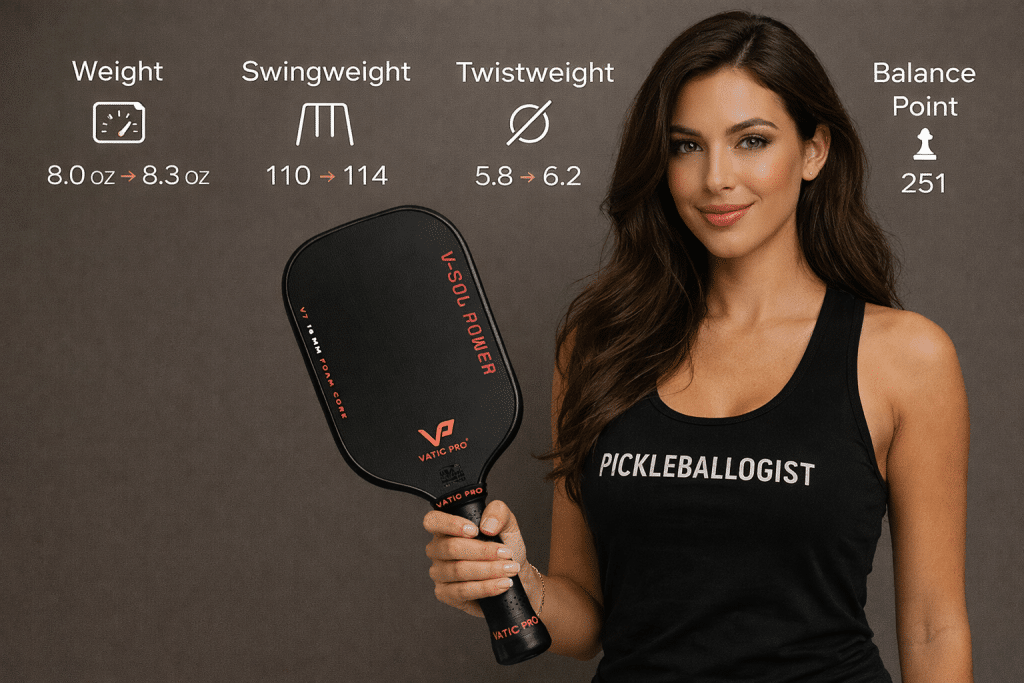
Playing with the V-SOL Power was an interesting contrast to the Pro. My demo was a V7 shape (elongated 16.5″ x 7.5″) at 8.1 oz. It swung a bit heavier – swingweight ~117, twistweight ~5.9 in that long-handle config. Immediately I felt the difference: the Power has a very dampened feel. Contact is ultra-soft and quiet; it feels like the paddle face “absorbs” the ball’s energy. This gave fantastic comfort (zero vibration feedback – my hands loved it) but also meant the paddle didn’t shoot the ball out unless I made it. In fact, the V-SOL Power does not provide much free power on its own. Counterintuitive as it sounds, a paddle named “Power” actually required me to swing harder to generate pace, because the foam core deadens the rebound a bit. It’s akin to a heavy hammer – if you get it moving, it hits very hard, but if you just poke at the ball, it’s quite gentle.
Once I adjusted and started taking full strokes, I discovered the V-SOL Power’s hidden gear: when you leverage your own strength, this paddle can crush the ball. My drives with the Power, when I really went after them, were absolute lasers – faster by a few MPH compared to the Pro or Saga (the kind of pace that opponents notice immediately). The Power’s swingweight being higher contributed to that heavy ball feel. On smashes and drives, it was superb; I felt like I could end points at will if I had time to set up and swing big. On the flip side, in the short game, it’s extremely controlled. Because it’s so muted, dinks and blocks stayed low and didn’t pop up. In fact, at times I left a dink too low or into the net because I was used to more bounce – the Power just kinda deadened it. Once I got the touch, I appreciated that I could swing on a fifth shot drop and the paddle wouldn’t overshoot – great for consistency when opponents are hammering balls at you.
However, I’ll note a couple of challenges: feedback and sweet spot. The V-SOL Power’s muted nature means you get very little feedback on contact – it’s almost too smooth. I sometimes wasn’t sure if I hit the center or not because the feel is so uniform. Some players love that plush sensation, others might find it “numb.” Also, I noticed (and the data confirms) the sweet spot felt a bit smaller than the Pro’s. When I hit near the edge, the Power lost more power than the Pro did. Possibly because the Pro’s EVA foam ring helps on perimeter hits, whereas the Power is just solid foam which can’t flex as much at the edges. It’s still more forgiving than a typical honeycomb paddle, but among foam paddles it’s average in forgiveness. Weighting at 3/9 o’clock can help, but perhaps not as dramatically as on the Pro.
Overall, the V-SOL Power struck me as a paddle for big hitters who want a soft feel. It truly reminded me of some previous gen foam models and even of the 16mm Saga in character – meaning muted, controllable power without a trampoline effect. In fact, if you already owned a Saga, the upgrade to V-SOL Power would feel subtle; their style is close. The main advantage of the Power is that it’s a foam core (so it won’t break down or “hot spot” over time like polymer cores can) and it provides that unique combo of power + plush comfort.
Is the V-SOL Power too powerful for most players?
Surprisingly, no – it’s powerful but in a very controlled way. Many hear “foam core” and assume a rocket launcher that only pros can handle. The V-SOL Power isn’t like that. Because it doesn’t give you free pop on small swings, a 3.5 or 4.0 player with decent mechanics can actually wield this paddle without spraying balls long. I’d actually say the V-SOL Pro feels “hotter” in hand at first (because of its easy pop) whereas the Power feels softer. However, if a player cannot generate fast swing speed on their own, they might struggle to tap the Power’s potential. Remember, when you swing big, the Power will hit big. If your technique is off or you’re late, the ball might just die off your paddle because the Power isn’t helping you much unless you swing through.
For an intermediate player who’s developing a fast game, the V-SOL Power can be an asset – it’s like a sleeping giant: controlled in hands, explosive when you call on it. I did find that against strong bangers, I could block and counter very effectively with the Power; the paddle wouldn’t be pushed around due to its heft and stability. It performs great at the net for defense. But when I decided to attack, I had to commit 100% – half-measures produce mediocre results with this paddle. In summary, the V-SOL Power is powerful but not “unruly.” As long as you’re honest about your skill (if you tend to pop balls up defensively, a super poppy paddle might hurt you more), the Power could actually improve your soft game consistency while still giving you knockout power on demand.
Pros (V-SOL Power):
- Huge power ceiling: When you unleash full swings, few paddles hit a heavier, faster ball – you can blow shots by opponents when timed right.
- Extremely muted & arm-friendly: Absorbs vibrations and shock almost completely. Comfortable for hours of play; excellent for tennis elbow prevention.
- Stable and solid: The additional weight and foam structure make it very stable on blocks and drives. It feels substantive, helping you absorb and redirect hard shots with ease.
Cons (V-SOL Power):
- Requires your own power: Ironically, it doesn’t feel powerful on casual swings – no easy pop. Players with shorter strokes might find it too low-powered unless they swing harder.
- Muted feedback: The feel is so dampened that you get little sensory feedback. Some may describe it as feeling “dull” or not knowing where you hit the ball on the face. This can affect touch for those who rely on that feedback.
- Slightly smaller sweet spot: Off-center hits lose more pace compared to V-SOL Pro. It’s still forgiving overall, but misses near the edge are not as forgiving as one might expect from a foam core.
How does the V-SOL Power compare to other power paddles (CRBN, Selkirk, Honolulu)?
Finally, let’s put the V-SOL Power against a few popular “power class” contenders:
| Power Paddle | Tech | Power | Control | Feel | Stability | Price |
|---|---|---|---|---|---|---|
| Vatic V-SOL Power (16mm) | Full foam core (indented) | High (on big swings; one of the hardest hitters when swung fast) | Med-Good (very controllable soft game for a power paddle) | Very muted, damp (low feedback) | High (foam + weight = stable, but sweet spot slightly smaller than Pro) | $109 |
| CRBN TruFoam 16mm (“Genesis”) | Full foam core (cutouts) | Very High (ball explodes when middled) | Medium (challenging on touch until mastered) | Muted, smooth (similar damp feel) | High (foam’s uniform face = stable; 16mm shape aids) | $249 |
| Selkirk Project 002 (19mm)** | Polymer + Toray carbon (innovative throat) | Med-High (surprising power for polymer, but not foam-level) | Excellent (designed for control and consistency) | Plush, slightly springy (unique thick feel) | High (19mm thick, very large sweet spot) | $333 (limited) |
| Honolulu J6 (Foam core) | Full foam core (new gen) | Very High (one of the top in raw power) | Medium (more controllable than CRBN but still a lot of juice) | Muted plush (foam feel, a bit more feedback than V-SOL Power) | High (solid stability, good sweet spot) | ~$199 |
**(Selkirk’s Project 002 is a limited-edition control paddle, included here as a contrast – it’s not foam, but a high-end power/control polymer paddle many 4.5+ players know.)
Summary: The V-SOL Power is squarely aimed at the same players considering a CRBN TruFoam (Genesis) or other foam power paddle. In that battle, the differences are subtle – both have that muted feel and big potential power. The CRBN might be a touch bouncier initially (and it costs over twice as much), whereas the Vatic Power is a bit more subdued until you crank it. I’d say CRBN’s foam is for the all-out aggressive player who wants max pop, while Vatic’s Power is for the player who wants power with a safety net (hard to overhit with unless you really go for it). Compared to Selkirk’s 002 – that paddle is a control beast with some power, but still polymer, so it actually has more inherent pop on soft shots than V-SOL Power does. The 002 is incredibly plush and easy to control, but it won’t give you the bash that foam can on smashes. A better Selkirk comp might be their upcoming Power Lab projects, but those aren’t widely available. Finally, the Honolulu J6 foam paddle is a close competitor: from my hits with a friend’s J6, I found it also very muted but maybe slightly easier to get power on moderate swings than the Vatic Power. The J6 in the hands of a high-level player is lethal, but for many it might be “too much paddle.” The Vatic V-SOL Power, by contrast, feels like it tempers that extreme power just enough to be playable for a wider audience. It’s a smartly designed paddle – in fact, it felt so much like the Saga 16 to me that I’d call it an incremental upgrade rather than a completely new experience. If you loved the Saga but wished for foam durability and a tad more put-away power, the V-SOL Power is a no-brainer.
Final Thoughts
Vatic Pro has really impressed me with this paddle lineup. For a 4.0 player like myself, these paddles hit a sweet spot of performance, comfort, and price. The Prism and Saga offer fantastic options for players developing their control game or seeking a balanced all-court paddle without spending a fortune. The Prism, especially, is a gem for control aficionados – no wonder it’s often recommended as a top budget control paddle. The Saga shows you can add power and still keep that plush feel many of us prefer. And with the V-SOL series, Vatic has kept pace with cutting-edge foam tech. The V-SOL Pro and Power paddles deliver high-end performance that rivals paddles 2-3x their cost, each catering to different styles. After weeks of testing, I personally gravitated toward the V-SOL Pro as my favorite (I enjoy its quick, lively feel), but I could easily see a tournament player choosing the V-SOL Power for its heavy drives, or a control strategist sticking with the Prism for consistency.
For 3.5 to 4.5 players in the 40+ age bracket, I’d summarize my advice like this: If control and consistency are your main concerns, go Prism. If you want a bit more offense without sacrificing touch, Saga is ideal. If you’re ready to embrace foam tech – choose Pro for a balanced upgrade or Power for a softer-feeling bazooka. All of them provide great spin and are gentle on the arm, which is so important as we get older. Vatic Pro has proven that you don’t need to pay $200+ to get a high-performing paddle. They’ve created paddles that punch up – competing with the big brands and, in some areas, outshining them. After my playtesting, my bag now contains a Vatic for every occasion: Prism for a finesse day, Saga when I want a jack-of-all-trades, Pro for fast doubles action, and Power when I’m feeling like crushing some drives. It’s been a blast testing these, and I hope this deep-dive helps you find the perfect paddle for your game!

I hail from the picturesque landscapes of Denver, Colorado, where the pickleball scene is as vibrant as our city's sunsets. The game has changed my life in ways I never thought a sport could. You see, before I got hooked, my closest encounter with a racket was a fly swatter.
As far as my coaching credentials go, well, it's a classic underdog story. I was once the guy who couldn't tell a pickleball paddle from a pizza peel, and now I'm proudly sporting the title of Master Teaching Professional from the IPTPA. If that doesn't give hope to all my fellow klutzes, I don't know what will!
My love for pickleball goes far beyond the court. I run the In2Pickle YouTube channel, which is a blend of pickleball tactics, bloopers (mostly mine), and heartfelt stories from players whose lives have been touched by the sport. If you're more into listening than watching, you can catch me chatting about everything pickleball-related on my Pickleball Therapy podcast. And if that isn't enough, I've also penned a book titled "Play Pickleball", where I share everything from basic rules to advanced strategies, and of course, anecdotes of my own hilarious mishaps.
- CRBN 1X X Series 14mm Review: The Spin Monster Is Suddenly Interesting Again Review - August 17, 2026
- LUZZ Cannon Review: A $109 Power Paddle With Champagne-Paddle Audacity - August 11, 2026
- Vatic Pro Paddles Review: Prism, Saga, and V-SOL Series - May 4, 2026