LUZZ Cannon Review: A $109 Power Paddle With Champagne-Paddle Audacity

The LUZZ Cannon is what happens when a budget paddle wanders into the premium-power section, eats somebody’s lunch, and refuses to leave. At $109, this elongated Gen 3+ thermoformed paddle brings serious baseline pace, excellent spin, and tournament-ready dual certification without charging the usual $280 emotional-support fee. It is not gentle, weightless, or beginner-proof—but for an aggressive player with decent hands, the value proposition is borderline rude.
For this review, we ran the Cannon through the Pickleballogist panel framework: Brenton judged its all-court usefulness and tennis-style offense, Sophie focused on doubles speed and social-rec playability, Mason attacked it like a former college tennis player, and Lleyton evaluated whether its power remains usable when points get fast and tactical. Their takes are combined with LUZZ’s published specifications, independent measurements, and construction research.
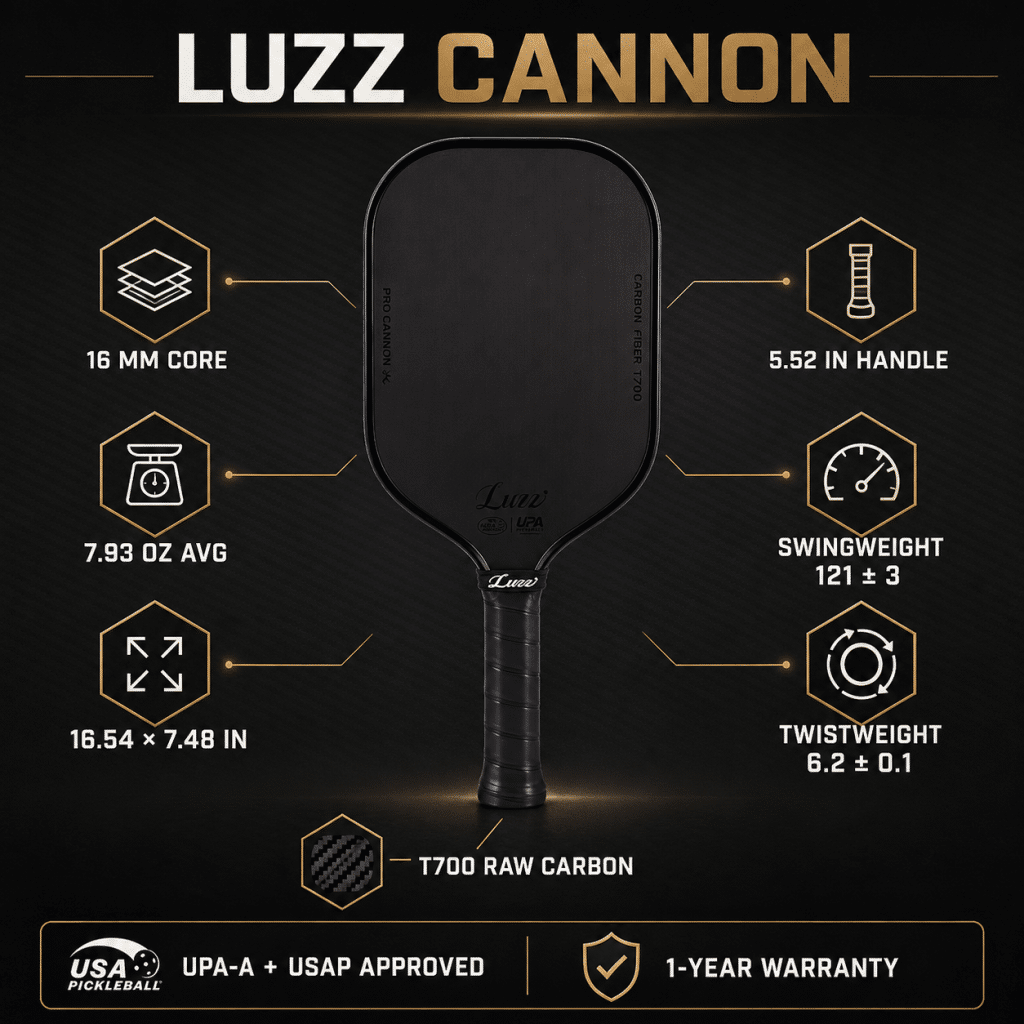
Specs & What They Promise
- Static Weight: 7.93 oz average
- Core: 16 mm polypropylene honeycomb with a full EVA foam perimeter; Gen 3+ thermoformed construction
- Face Material: T700 raw carbon fiber with directional friction texture
- Dimensions: 16.54 in long x 7.48 in wide
- Handle Length: 5.52 in
- Grip Circumference: 4.13 in
- Swingweight: 121 ± 3
- Twistweight: 6.2 ± 0.1
- Measured Spin: approximately 2,252 RPM in an independent test
- Certification: UPA-A and USA Pickleball approved
- Warranty: 1 year
- MSRP: $109 at time of research
Power & Pop: Yes, the Name Is Obnoxiously Accurate
The Cannon is a genuine power paddle, not a control paddle wearing a leather jacket for the product photos. Its elongated 16.54-inch shape, thermoformed shell, foam perimeter, and 121 ± 3 swingweight put real mass behind serves, returns, and drives. Independent comparisons found its full-swing power nearly identical to the JOOLA Perseus Pro IV, although the JOOLA supplies a little more automatic pop on hurried blocks and counters. That distinction matters: the Cannon rewards a committed swing more than it rewards merely existing near the ball. The tradeoff is obvious at the kitchen. A swingweight around 121 produces lovely plow-through but is not exactly caffeinated during rapid hand battles. Players moving from a quick hybrid paddle will notice the extra lumber. If you want effortless offense and can prepare early, wonderful. If your favorite defensive technique is panicked wrist-flailing, this paddle will document the crime scene.
Spin & Bite: The Surface Has Actual Teeth
The T700 raw-carbon face is one of the Cannon’s least subtle talents. An independent test reported roughly 2,252 RPM, which places it firmly in elite-spin territory rather than the marketing department’s enchanted forest. Reviewers consistently noted heavy topspin on drives, shaped drops, and aggressive rolls, with the directional texture retaining more obvious bite than some premium competitors. That does not make every flick land; physics remains annoyingly employed. But the combination of dwell, grit, and head mass makes it easy for a technically sound player to bend a drive down into the court. For more context on how modern core construction affects feel and performance, see our foam-core paddle guide.
Control & Soft Game: Surprisingly Civilized, Still Carrying a Weapon
For this much power, the Cannon is more manageable than it has any right to be. The full EVA foam perimeter enlarges and stabilizes the usable hitting area, while the 16 mm honeycomb core keeps drops and resets from feeling like you are performing surgery with a shovel. Multiple playtests describe better kitchen control and mishit recovery than the Perseus Pro IV. Still, ‘good control for a power paddle’ is a sentence with an important final clause. The face can feel soft or slightly mushy on gentle contact, and the launch response changes when the paddle is swung hard. That dual personality takes calibration. Beginners who regularly float dinks will not be spiritually healed by buying more horsepower. Intermediate-to-advanced attackers, especially tennis converts, are the natural audience.
Sweet Spot & Stability: Good, Not Babysitter Good
A published twistweight of 6.2 ± 0.1 is respectable for an elongated paddle and helps the Cannon resist twisting on near-center contact. The foam perimeter also gives it a more coherent edge response than old-school thermoformed power paddles. But this is not a widebody forgiveness barge. High and lateral misses still lose pace and directional certainty, and several independent reviewers specifically warned that the paddle rewards clean contact. That is why the Cannon makes more sense for confident 3.5-plus players than for a brand-new player trying to locate the sweet spot with a search party. If maximum forgiveness matters more than maximum violence, our Honolulu J2K review covers a friendlier alternative.
Construction, Approval & Durability
The Cannon is not a full-foam paddle. It uses a polypropylene honeycomb core surrounded by EVA foam, then wraps the structure in a thermoformed carbon shell. Think modern Gen 3 construction with an unusually complete foam ring—not the solid foam panel used by paddles such as CRBN TruFoam. X-ray comparisons show foam extending around the perimeter and into the throat area, a design intended to improve stability, power retention, and structural consistency. LUZZ calls it Gen 3+ and promises no performance drop-off; sensible buyers should translate that as a design goal, not a law of nature. The concrete protections are better: the current Dual Certification version is listed by LUZZ as UPA-A and USA Pickleball approved and carries a one-year warranty. If you want the genuinely all-foam side of this technology debate, read our CRBN TruFoam series review.
Value: Premium Performance Without the Country-Club Invoice
At a published $109 MSRP, the Cannon’s argument is devastatingly simple. It delivers credible premium-level power, elite spin, dual tournament certification, and a one-year warranty for less than half the price of several flagship paddles. The comparison is not perfect—premium brands may provide stronger retail support, tighter quality control, or a more polished grip and finish—but the performance gap is nowhere near the price gap. This is the paddle equivalent of discovering that the restaurant’s $14 house wine is better than the $38 bottle your friend ordered because he recognized the font. For another strong sub-$100-to-$150 family, see our Vatic Pro paddle comparison.
“The Cannon gave me the kind of free depth that makes a former tennis player feel ten years younger and approximately 40 percent more obnoxious. My drives dipped hard, but in quick kitchen exchanges the 121-ish swingweight occasionally arrived after the meeting had ended.” -Brenton Cashmore — 3.5 player and former tennis player
“I loved the spin and the price, but I had to shorten everything at the kitchen. When I got lazy, the Cannon didn’t gently correct me—it launched my mistake toward the back fence with supporting documentation.” -Sophia Martinez — 3.5 tournament player
“This paddle wants you to attack. Serves, thirds, and counters came off heavy, and the elongated handle felt natural on a two-handed backhand. It isn’t the quickest paddle in a firefight, but if you prepare early, it hits a brutally heavy ball for $109.” -Mason Kelley — 4.5 player and former D3 tennis player
“The impressive part isn’t simply that the Cannon is powerful; plenty of paddles can turn a bad decision into a faster bad decision. The impressive part is that an experienced player can still shape drops, roll volleys, and reset with it after adjusting to the lively response.” -Lleyton Howard — 5.0 player and pickleball coach
Pros & Cons
| What We Liked | What You Should Know |
|---|---|
| Premium-tier drive and serve power for $109 | 121 ± 3 swingweight can feel slow in hand battles |
| Approximately 2,252 RPM measured spin | Less forgiving than hybrid and widebody alternatives |
| More controllable than many high-pop Gen 3 paddles | Soft-contact feel can seem mushy or inconsistent at first |
| UPA-A and USA Pickleball dual certification | Power profile is a poor match for true beginners |
| One-year warranty and foam-reinforced perimeter | Stock grip may benefit from an overgrip for sweaty hands |
How the LUZZ Cannon Scores Against Power-Paddle Rivals
| Paddle | Power | Spin | Forgiveness | Control |
|---|---|---|---|---|
| LUZZ Cannon | 9.2 | 9.3 | 7.7 | 7.9 |
| JOOLA Perseus Pro IV 16mm | 9.3 | 8.4 | 7.4 | 7.5 |
| 11SIX24 Alpha Pro Power | 8.8 | 8.8 | 8.1 | 8.2 |
| Vatic Pro V-SOL Pro V7 | 8.8 | 9.0 | 8.0 | 8.0 |
Final Verdict
The LUZZ Cannon is not the best paddle for everybody, because no paddle is—and anyone saying otherwise is either selling one or has recently suffered a head injury. But for a competent attacker who likes an elongated shape, heavy spin, and deep penetrating drives, it may be the sharpest value in its category. The Cannon does not beat every premium rival at every task. It does something more embarrassing: it gets alarmingly close while leaving roughly $170 in your pocket. Use that money for lessons. Or court shoes. Or an unnecessarily elaborate post-game burrito. All three will improve your life more than a prestige logo.
LUZZ Cannon Review: A $109 Power Paddle With Champagne-Paddle Audacity FAQ
❓Is the LUZZ Cannon USA Pickleball approved?
Yes. LUZZ lists the current Dual Certification Cannon as approved by both USA Pickleball and UPA-A, making it eligible for sanctioned competition under those organizations. Because certification lists can change, tournament players should verify the exact model markings against the current approved-equipment database before an event.
❓Is the LUZZ Cannon a full-foam-core paddle?
No. The Cannon uses a polypropylene honeycomb core with a full EVA foam perimeter and thermoformed carbon construction. That is different from a true full-foam paddle, where foam replaces the honeycomb panel throughout the core.
❓How powerful is the LUZZ Cannon?
It sits firmly in the high-power category. Independent testers have compared its serve, return, and drive power favorably with the JOOLA Perseus Pro IV. Its 121 ± 3 swingweight adds plow-through, while the thermoformed shell and foam perimeter help return energy on full swings.
❓Does the LUZZ Cannon have good spin?
Yes. One independent test measured approximately 2,252 RPM from its T700 raw-carbon friction face, an elite result. Testers also consistently report strong topspin on drives, rolls, and shaped drops.
❓Is the LUZZ Cannon good for beginners?
Usually not. The high power, elongated shape, smaller margin on off-center hits, and 121-range swingweight demand more preparation and face control than most beginners possess. A more forgiving hybrid or widebody control paddle will generally make learning easier.
❓How does the LUZZ Cannon compare with the JOOLA Perseus Pro IV?
The Cannon offers similar full-swing power, more obvious surface grit, and—according to several independent reviewers—better control on drops, resets, and dinks. The Perseus Pro IV feels quicker and supplies slightly more automatic pop on blocks and counters. The Cannon’s overwhelming advantage is price: its published MSRP is $109 versus a premium flagship price for the JOOLA.
❓Who should buy the LUZZ Cannon?
Aggressive 3.5-and-up players, tennis converts, and confident singles players are the clearest fit. It particularly suits someone who creates offense with full swings, values spin and plow-through, and does not need a feather-light paddle at the kitchen.
❓Does the LUZZ Cannon need a break-in period?
Independent testers report strong power immediately, with only a small increase during roughly the first ten hours. That is less dramatic than the lengthy break-in associated with some earlier Gen 3 thermoformed paddles, but individual units and perceptions can vary.

I hail from the picturesque landscapes of Denver, Colorado, where the pickleball scene is as vibrant as our city's sunsets. The game has changed my life in ways I never thought a sport could. You see, before I got hooked, my closest encounter with a racket was a fly swatter.
As far as my coaching credentials go, well, it's a classic underdog story. I was once the guy who couldn't tell a pickleball paddle from a pizza peel, and now I'm proudly sporting the title of Master Teaching Professional from the IPTPA. If that doesn't give hope to all my fellow klutzes, I don't know what will!
My love for pickleball goes far beyond the court. I run the In2Pickle YouTube channel, which is a blend of pickleball tactics, bloopers (mostly mine), and heartfelt stories from players whose lives have been touched by the sport. If you're more into listening than watching, you can catch me chatting about everything pickleball-related on my Pickleball Therapy podcast. And if that isn't enough, I've also penned a book titled "Play Pickleball", where I share everything from basic rules to advanced strategies, and of course, anecdotes of my own hilarious mishaps.
- CRBN 1X X Series 14mm Review: The Spin Monster Is Suddenly Interesting Again Review - August 17, 2026
- LUZZ Cannon Review: A $109 Power Paddle With Champagne-Paddle Audacity - August 11, 2026
- Vatic Pro Paddles Review: Prism, Saga, and V-SOL Series - May 4, 2026