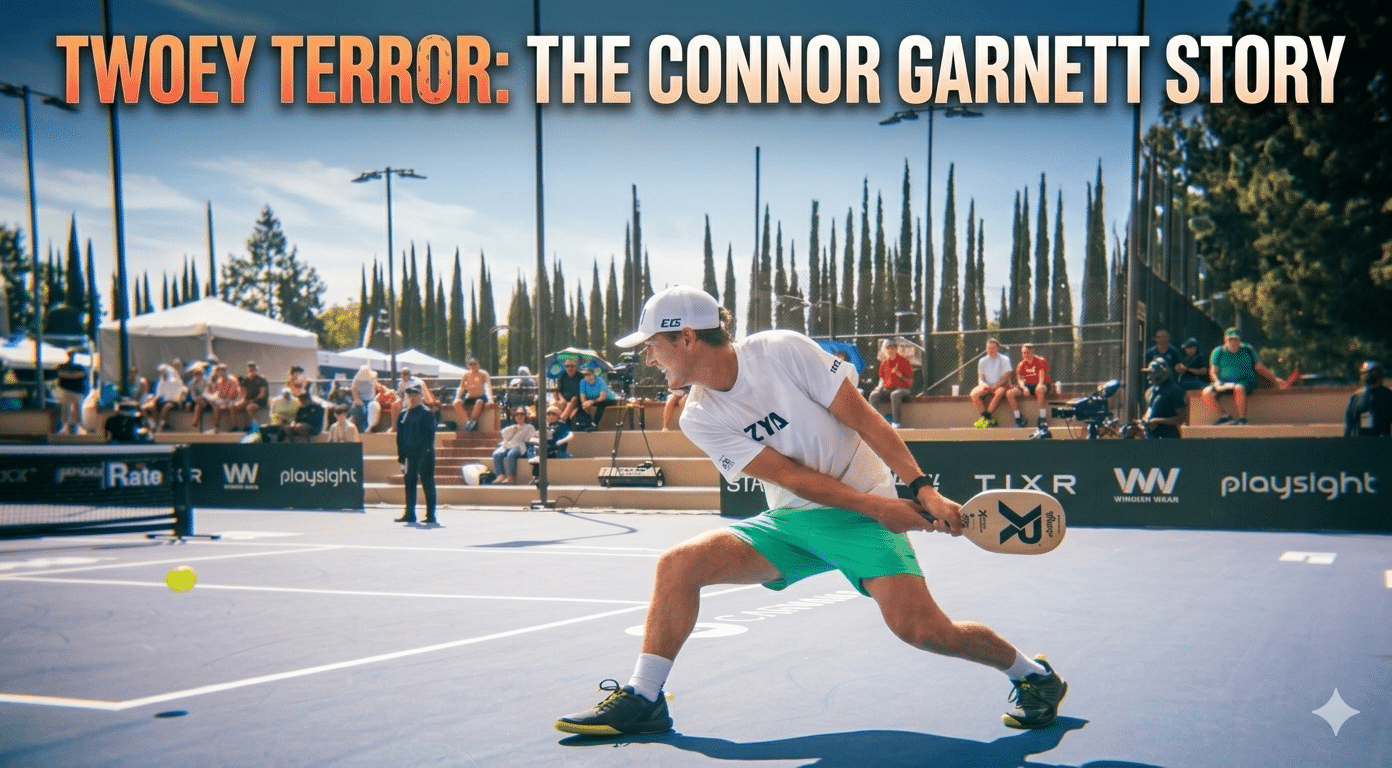
There’s a certain kind of player who makes you uneasy before the first serve is even struck. It’s not the loud ones or the chest-thumpers. It’s the players who look like they’ve already solved the puzzle—like they’re just waiting for the rest of us to catch up. Connor Garnett fits that mold perfectly. You watch him warm up and there’s no wasted motion, no theatrics. Then the match starts, and before you realize what’s happening, he’s dictating everything—tempo, angles, pressure. It’s not overwhelming in the traditional sense. It’s suffocating.
The Backstory: Built Different Before Pickleball Even Started
Most pro pickleball players have a familiar origin story. They played tennis at a decent level, discovered pickleball, and rode the wave. Garnett’s path feels like it skipped a few levels.
He comes from high-level tennis—serious, structured, professional-track tennis. The kind where becoming a hitting partner for Novak Djokovic isn’t a pipe dream, it’s a plausible outcome. That matters more than people realize. Training in that environment rewires how you see the court. You’re not just reacting to the ball—you’re anticipating sequences, manipulating space, and understanding timing at a level most players never touch.
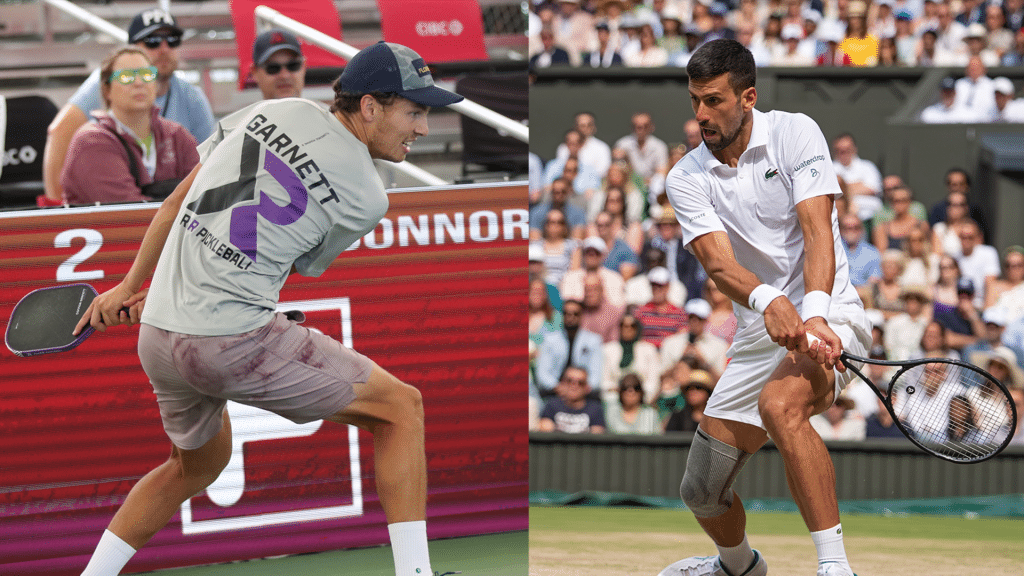
That DNA carries over. When Garnett stepped into pickleball, he didn’t look like someone learning a new sport. He looked like someone translating an existing language into a new dialect.
The Detour That Explains Everything
Before fully committing to pickleball, Garnett took a turn into finance. And oddly enough, that might be the most revealing part of his story.
Because when you watch him play, it doesn’t feel emotional. It feels… optimized.
There’s a clear sense of:
- calculated risk-taking
- controlled aggression
- constant evaluation mid-point
He doesn’t rush into chaos—he chooses when to enter it. He’s not guessing. He’s allocating. Every speed-up, every counter, every early contact point feels like a decision that’s already been weighed and approved.
It’s like watching someone trade stocks in real time—except the currency is court position and milliseconds.
His Playing Style: Controlled Disruption
Trying to describe Garnett’s game using traditional pickleball language doesn’t quite work. He’s not a “soft game specialist,” but he’s not a reckless banger either. What he really does is disrupt patterns—constantly.
He takes the ball early in a way that feels almost rude. Not just stepping in on dinks, but cutting off shots before they fully develop. That alone changes everything for his opponents. Time disappears. Options shrink.
And then there’s his willingness to attack from positions most players are taught to neutralize. That midcourt zone—where coaches usually scream “reset!”—is where Garnett often goes on offense. It’s uncomfortable to watch because it breaks the rules most of us rely on.
But here’s the thing: it works because his hands are absurdly fast, and his reads are even faster. He’s not just reacting quicker—he’s seeing the next shot before it happens.
Watching him feels like watching someone bend the geometry of the court.
The Mental Game: Quiet Pressure That Builds and Builds
If you’ve ever played someone who gives you nothing emotionally—no frustration, no excitement, no tells—you know how unsettling that can be. Garnett lives in that space.
There’s no theatrics. No momentum swings driven by emotion. Just steady, relentless pressure.
You might start a game feeling fine, trading points, thinking you’re right there. Then you glance at the score and it’s 8–2, and you can’t quite explain how it happened. That’s his superpower. He doesn’t blow you off the court—he slowly removes your options until you run out of answers.
What Paddle Does Connor Garnett Use?
The Paddle: ProXR Connor Garnett Signature (14mm)
You can learn a lot about a player by the paddle they choose. In Garnett’s case, it tells you everything.
This is not a forgiving paddle. It doesn’t smooth over mistakes or add artificial stability. Instead, it amplifies what you bring to the table. If your mechanics are sharp and your timing is early, it feels like an extension of your hand. If you’re late or sloppy, it exposes you immediately.
The 14mm core is a big part of that identity. Thinner paddles tend to favor speed and responsiveness over plush control, and that’s exactly what this one delivers. It’s quick through the air, easy to maneuver in tight exchanges, and built for players who want to take time away from their opponents rather than absorb pace.
The Handle: More Than a Gimmick
ProXR’s angled handle design is one of those features that sounds like marketing until you actually feel it.
What it does is subtly change your wrist position and paddle face orientation, especially in fast exchanges. For a player like Garnett—who thrives on micro-adjustments and rapid redirections—that matters. It allows him to stay compact while still generating sharp angles and quick counters.
You’re not taking big swings with this setup. You’re making constant, tiny corrections at high speed. And the handle helps facilitate that.
On-Court Performance: Where It Shines (and Where It Doesn’t)
At the kitchen, this paddle feels like a weapon. Hands battles become less about survival and more about control. You can redirect pace, change direction, and end points quickly if you’re confident in your reactions.
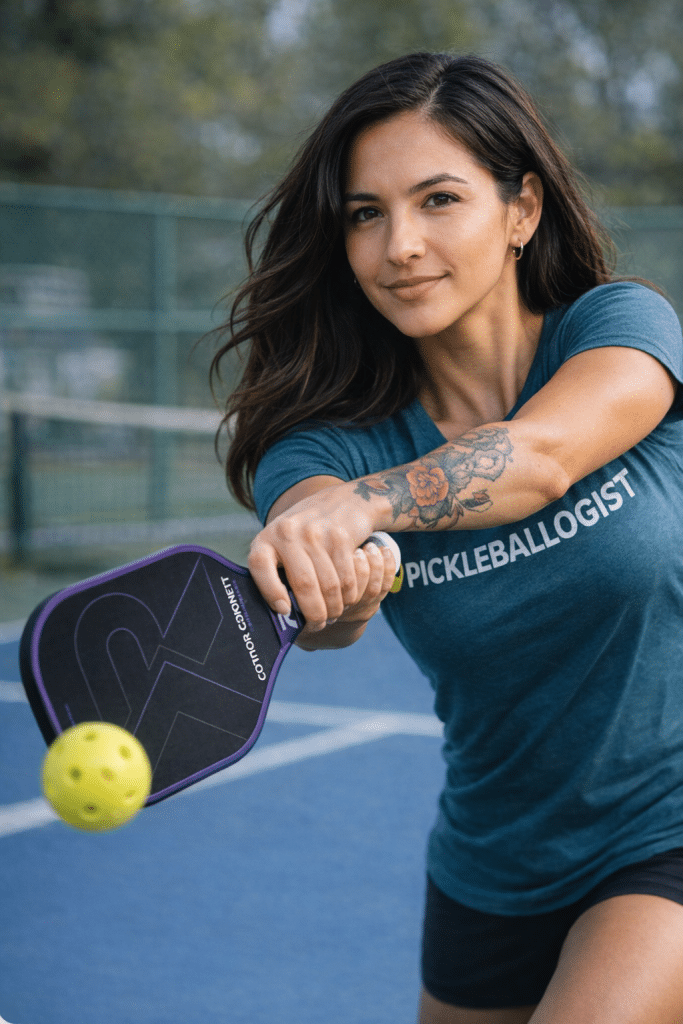
But that same responsiveness comes with a cost.
In the reset game, there’s less margin for error. You can’t rely on the paddle to absorb pace for you. You have to provide the touch yourself. If you’re late or off-balance, the ball will let you know immediately.
Power-wise, it’s not designed to overwhelm opponents with brute force. Instead, it offers controlled pop—enough to finish points, but in a way that prioritizes placement and timing over sheer speed.
What Our Playtesters Felt
One of the things we care about most is how different player types experience the same paddle, because that’s where the real story shows up.
Brenton described it as a paddle that made him feel faster, but also more exposed—like it was challenging him to rise to its level. Sophia loved it at the net but noticed immediately how unforgiving it was when she got even slightly late on a shot. Mason, coming from a tennis background, felt like it unlocked instincts he hadn’t been able to access with more forgiving paddles. And Lleyton summed it up in the most coach-like way possible: it’s an advanced tool, not a development tool.
Those layered reactions are exactly what we expect to see across skill levels when a paddle leans this heavily into performance over forgiveness .
Connor Garnett’s Shoes: Built Like a Tank for Baseline Warfare
Connor Garnett has been spotted wearing the K-Swiss Ultrashot 3HB series, a high-performance tennis shoe designed for aggressive, explosive players. While the exact model he’s worn (like the Ultrashot 3) is getting harder to find, the DNA of the shoe tells you everything about his game.
The Ultrashot line is known for its stiff, structured feel and elite lateral support—a combination built for players who live in side-to-side movement and punish the court with hard stops and explosive pushes.
This isn’t a “light and airy” shoe. It’s a planted, confident, stability-first weapon.

K-Swiss Men’s Ultrashot Light Pickleball Tennis Shoe Stable
With features like a reinforced outsole, a full support chassis, and one of the grippiest traction patterns in tennis footwear, it’s designed for players who:
- Slide into shots
- Load hard on their legs
- Trust their footwear not to fold under pressure
That’s exactly how Garnett plays—especially on that two-handed backhand, where balance and stability matter more than anything.
The Closest Alternative You Can Actually Buy
Since the original Ultrashot model Connor wore is tough to find, the best move is to go with the modern evolution of that same shoe line:
👉 K-Swiss Ultrashot (Team / 4 / newer variants)
These keep the same core DNA:
- Same lateral support system
- Same durable outsole concept
- Same “planted” feel underfoot
But with slightly more comfort and updated materials.
Most rec players think:
“I need a lighter shoe to move faster”
Wrong.
If you play anything like Garnett—or want to—you need:
- A shoe that lets you plant without hesitation
- A base that doesn’t collapse when you load your legs
- Confidence to hit without thinking about your feet
That’s what the Ultrashot gives you.
Connor Garnett’s Best Matches & Career Highlights (Watch the Tape)
This is where Garnett stops being “interesting” and starts being legitimately dangerous.
Because you can talk about his Twoey all day… but until you watch it under pressure, you don’t really understand what he’s doing to people.
The Breakout: PPA LA Open — “Oh… this guy is different”
This was one of those early tournaments where people stopped treating Garnett like “another tennis convert” and started realizing:
This dude is playing a different tempo.
What stands out immediately is how early he’s taking the ball. Not just stepping in—but cutting points short before they fully develop.
You’ll see:
- Backhand counters off balls most players reset
- Baseline exchanges that look more like tennis than pickleball
- The early formation of what would become his Twoey identity
This is Garnett before he fully weaponized his style—and he’s still making pros uncomfortable.
The Statement Matches: Red Rock Open vs Christian Alshon
This is the match you show someone when they say,
“Yeah but does that backhand thing actually work against elite players?”
Yes. Yes it does.
This is chaos vs chaos—but Garnett’s version is more calculated.
Watch closely:
- How often he chooses backhand over forehand (on purpose)
- His ability to go defense → offense in one shot
- The way he redirects pace instead of absorbing it
Alshon brings heat. Garnett brings structure inside the chaos.
And that’s the difference.
The Resume Moment: PPA Asia Triple Crown
There isn’t one viral YouTube clip that defines this run—which honestly makes it more impressive.
Because this wasn’t about highlights.
This was about winning everything.
- Singles
- Doubles
- Mixed
That’s a Triple Crown. And not in a soft draw either.
This is where Garnett proved something important:
He’s not just a stylist. He’s a competitor.
Winning across formats means:
- Adjusting pace
- Managing partners
- Playing different roles
A lot of flashy players fall apart outside their lane.
Garnett doesn’t.
The Grinder Moments (Where You Learn the Most)
Not the wins.
The battles.
There are matches where:
- He gets pushed deep into rallies
- Opponents try to slow him down
- The Twoey gets tested under pressure
And instead of abandoning it?
He leans in harder.
One of the wildest sequences fans have talked about:
Coming back from 0–10 down against Jack Sock to win 12–10
That’s not normal.
That’s not momentum.
That’s someone who trusts their system more than the scoreline.
Film Breakdown (This Is the Part That Matters)
If you’re actually studying Garnett—and not just watching highlights—here’s what to focus on:
1. Backhand Over Forehand (On Purpose)
Most players default to forehand.
Garnett often chooses backhand.
Why?
- Better control under pressure
- Faster reload
- More consistent angle generation
It’s not a limitation. It’s a strategy.
2. Early Contact = Time Theft
He’s not hitting harder than everyone.
He’s hitting earlier.
That:
- reduces opponent reaction time
- shrinks the court
- forces rushed decisions
This is the biggest separator at the pro level.
3. Midcourt Aggression (Where Most Players Panic)
That awkward transition zone?
Most players:
reset and survive
Garnett:
attacks and finishes
That’s where matches flip.
The 40+ Player Reality Check
This is where things get real for a lot of players.
Most players in the 40+ range aren’t looking for a paddle that punishes them. They want something that adds stability, increases forgiveness, and smooths out inconsistencies. This paddle does the opposite.
It rewards:
- early preparation
- fast hands
- confident decision-making
And it penalizes hesitation.
If your game is built around quick exchanges and taking initiative, you’ll probably love it. If your game leans more toward resets and consistency, it might feel like it’s working against you.
Why Garnett Actually Matters
Zooming out, Garnett represents something bigger than just one player with a unique style.
Pickleball is evolving. The traditional soft game is still foundational, but there’s a growing shift toward speed, early contact, and aggressive hand play. Garnett sits right at that intersection and pushes it forward.
He’s not abandoning control—he’s compressing time.
And that changes how the game is played.
Final Verdict
Connor Garnett isn’t just playing pickleball at a high level—he’s redefining what high-level looks like. His game challenges assumptions, his gear reflects his mindset, and his approach forces opponents into uncomfortable territory.
This isn’t a “plug-and-play” setup. It’s not designed to make the game easier.
It’s designed to make you sharper.
If you’re ready for that, it can feel like a cheat code.
If you’re not, it’ll let you know pretty quickly.
Either way, Garnett’s influence is only growing—and the rest of the game is starting to feel it.ng. Garnett’s own gear choices—especially the 6″ handle on his ProXR signature paddle—are basically screaming “two-handed backhand reps or perish.” And when the opponent gets hot, borrow his mental trick: breathe, stay loose, and treat the moment like a challenge instead of a threat.
Genius insight from Conor on how to use patterns to break down your opponents.

She began playing pickleball in her early twenties after a recreational tennis background and quickly fell down the strategy rabbit hole. What started as casual open play turned into structured training, league play, and consistent tournament participation. Over the past few years, Sophia has competed in APP-sanctioned and regional tournaments across the Southwest, including mixed and women’s doubles events, where she’s known for her court awareness, patient net game, and ability to adapt mid-match.
Off the court, Sophia has built a reputation as a thoughtful and honest pickleball writer. Her work focuses on gear performance, tournament preparation, and the realities of competitive amateur play—the stuff most rec players actually want to know. She has contributed articles and player perspectives to Pickleballogist, regional pickleball blogs, and community newsletters, with pieces covering paddle selection for intermediate players, tournament mindset, and how doubles strategy changes as competition tightens.
Unlike purely gear-driven reviews, Sophia’s writing leans heavily on match experience. She tests paddles and equipment in league play and tournaments—not just drilling sessions—and pays close attention to things like hand speed at the kitchen, reset consistency under pressure, and how a paddle behaves late in a long match. Her reviews are known for being practical, readable, and refreshingly hype-free.
By day, Sophia works as an event coordinator, a role that has made her particularly attuned to the logistics and flow of tournaments—from scheduling and court management to player experience. That background gives her a unique lens when writing about events, travel tournaments, and what separates well-run competitions from frustrating ones.
What truly sets Sophia apart is her connection to the pickleball community. She’s a familiar face at local open plays, leagues, and post-match hangouts, and she values the social side of the sport just as much as competitive growth. Whether she’s breaking down a paddle’s sweet spot, sharing lessons from a tough three-game loss, or recommending a tournament worth traveling for, her goal is always the same: help players make smarter choices and enjoy the game more.
Sophia brings a calm, knowledgeable, and down-to-earth voice to pickleball coverage—rooted in real play, real matches, and real improvement.
By day, I work as an event coordinator, planning everything from corporate retreats to local festivals. It's a job that keeps me on my toes and allows me to flex my creative muscles. But once the workday is over, you'll most likely find me on the pickleball court.
I've been playing in local and regional tournaments for a few years now, and while I'm not going pro anytime soon, I've held my own in some pretty competitive matches. I also love traveling to watch professional pickleball games; there's something electrifying about seeing the best in the world go head-to-head.
What I cherish most about pickleball, though, is the social aspect. I've met some of my closest friends through this sport, and our post-game hangouts are just as important to me as the games themselves.
I like to think I bring a down-to-earth vibe to everything I do. I love a good laugh, intelligent conversation, and, of course, a spirited game of pickleball. So if you're up for a match or just want to chat about the latest pro tournament, hit me up. I'm always game!